

What People In The 1700s Cleaned Wiped With
What did people apply earlier toilet paper was invented?

In the early days of the COVID-19 pandemic, toilet paper was nearly as difficult to come up past equally personal protective equipment. Though toilet paper has existed in the Western globe since at least the 16th century A.D. and in China since the second century B.C., billions of people don't use toilet newspaper fifty-fifty today. In before times, toilet paper was fifty-fifty more than deficient.
So what did ancient humans use to wipe later on going to the bathroom?
Information technology tin be hard to tell using the archaeological record, said Susan Morrison, a medieval literature professor at Texas State University and author of the volume "Excrement in the Middle Ages; Sacred Filth and Chaucer's Fecopoetics" (Palgrave Macmillan, 2008). "Nigh of the material we don't have considering it's organic and merely disappeared," Morrison told Live Science. Nevertheless, experts have been able to recover some samples — including some with traces of carrion — and depictions of toilet paper's precursors in art and literature.
Related: Why do some men have then long to poop?
Throughout history, people have used everything from their ain hands to corn cobs to snow to clean upward subsequently bowel movements. One of the oldest materials on record for this purpose is the hygiene stick, dating back to China 2,000 years ago, co-ordinate to a 2022 report in the Journal of Archaeological Scientific discipline: Reports. Hygiene sticks, also called bamboo slips, were wooden or bamboo sticks wrapped in material.
During the Greco-Roman flow from 332 B.C. to 642 A.D., the Greeks and Romans cleaned their derrières with another stick chosen a tersorium, according to a feature in the BMJ. The tersorium, which had a sponge on 1 end, was left in public bathrooms for communal use. Some scholars debate that the tersorium may not have been used to clean people's behinds but the bathrooms they defecated in. People cleaned the tersorium by dumping it in a bucket of table salt or vinegar water or by dipping it in running water that flowed beneath the toilet seats.
Greeks and Romans as well tidied up with ceramic pieces rounded in the shape of an oval or circle, called pessoi. Archaeologists have institute pessoi relics with traces of feces on them, and an ancient wine cup features a man wiping his bum with pessoi. Greeks may have likewise wiped with ostraka, ceramic pieces that they inscribed with the names of their enemies when voting to ostracize them. Afterward the vote, they may take wiped their feces on their enemies' names. However, these ceramic materials may have damaged the butt over fourth dimension, causing pare irritation and external hemorrhoids, according to the BMJ.
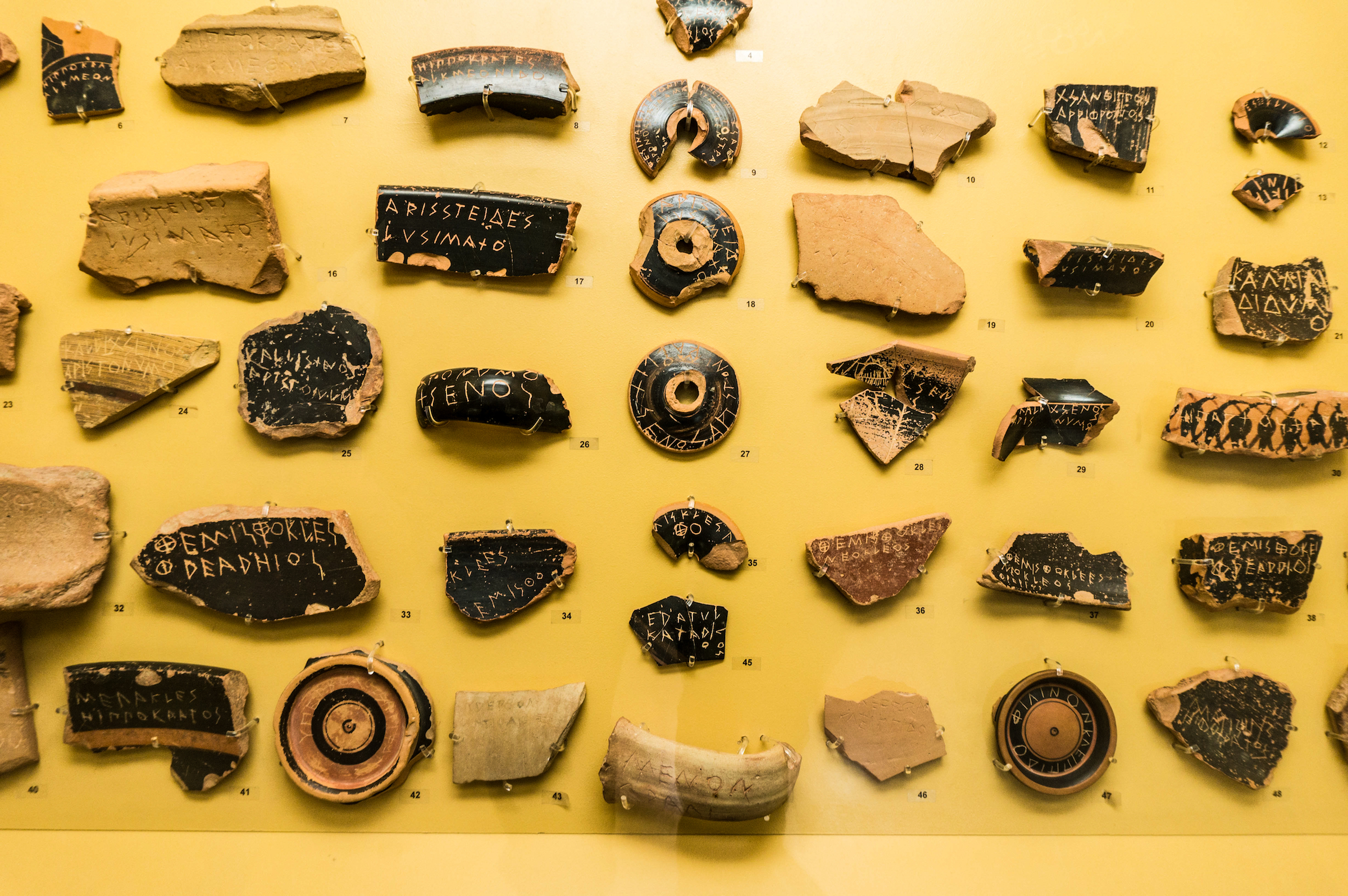
In Japan in the eight century A.D., people used another type of wooden stick called a chuugi to clean both the exterior and inside of the anus — literally putting a stick up their buttocks. And though sticks accept been popular for cleaning the anus throughout history, aboriginal people wiped with many other materials, such as h2o, leaves, grass, stones, animal furs and seashells. In the Middle Ages, Morrison added, people besides used moss, sedge, hay, straw and pieces of tapestry.
People used so many materials that a French novelist, François Rabelais, wrote a satirical poem on the topic in the 16th century. His poem gave the showtime mention of toilet paper in the Western world, but he called it ineffective. Rabelais instead concluded that a goose neck was the all-time selection. Though Rabelais was joking, "feathers would work as well every bit anything organic," Morrison said.
Granted, even today toilet paper isn't universal. For instance, the Australian news outlet SBS Punjabi lightheartedly mocked Westerns desperate for toilet paper early in the pandemic, urging them to "wash not wipe" with a gentle jet stream of water.
Originally published on Live Science.

Source: https://www.livescience.com/toilet-paper-history.html#:~:text=And%20though%20sticks%20have%20been,stones%2C%20animal%20furs%20and%20seashells.
Posted by: tolartherect.blogspot.com
0 Response to "What People In The 1700s Cleaned Wiped With"
Post a Comment