

How To Compress On Windows
File compression reduces the size of a file by cleverly taking out parts of the contents of the file that aren't needed, storing simply the minimum amount of information necessary to reconstitute the file — excerpt it — into its full original form. A sure amount of overhead is involved considering the Windows 10 computer must accept the time to clasp inapplicable data out of a file earlier storing information technology, and then the figurer takes more time to restore the file to its original country when someone needs the file. Simply compression tin reduce file sizes enormously. A compressed file often takes up half its original space — even less, in many cases.
How does pinch piece of work? That depends on the compression method you use. In 1 kind of compression, known as Huffman encoding, letters that occur frequently in a file (say, the letter e in a word-processing certificate) are massaged so that they take up just a little bit of room in the file, whereas messages that occur less oft (say, x) are allowed to occupy lots of space. Rather than allocate eight 1s and 0s for every alphabetic character in a certificate, for case, some letters may accept up merely two 1s and 0s, and others can have up 15. The net result, overall, is a big reduction in file size. It'due south complicated, and the mathematics involved get quite interesting.
Following are the two Windows 10 file compression techniques:- Files can exist compressed and placed in a compressed (zipped) folder. The icon for a zipped folder, appropriately, has a zipper on it.
- Folders or even unabridged drives can be compressed by using the built-in compression capabilities of the Windows file arrangement (NTFS).
NT file system (NTFS) compression is built in to the file organization: You tin can use it only on NTFS drives, and the compression doesn't persist when you move (or copy) the file off the drive. Call back of NTFS compression as a capability inherent to the hard bulldoze itself. That isn't actually the case — Windows does all the sleight-of-hand behind the scenes — merely the concept tin can help you remember the limitations and quirks of NTFS compression.
Although Microsoft would have you believe that compressed (zipped) folder compression is based on folders, it isn't. A compressed (zipped) folder is really a file — not a folder — but information technology's a special kind of file, chosen a zip file. If yous ever encountered goose egg files on the Net (they have a .zippo filename extension and are read and created directly in Windows File Explorer), you know exactly what this ways.
Zippo files comprise one or more compressed files, and they utilize the most mutual kind of compression institute on the Internet. Call up of compressed (zipped) folders as being zip files, and if you have fifty-fifty a nodding acquaintance with zips, you'll immediately sympathize the limitations and quirks of compressed (zipped) folders. Microsoft calls them folders because that's supposed to be easier for users to understand. Y'all be the judge.If yous accept Windows 10 show you filename extensions, you meet immediately that compressed (zipped) folders are, in fact, uncomplicated zip files.
Zipping is very common, especially because it reduces the amount of data that needs to be transported from here to there. NTFS compression isn't nearly every bit common. Information technology's more than difficult, and hard drives have become so inexpensive at that place's rarely whatsoever demand for nearly people to utilise it.
The table below shows a quick comparison of NTFS compression and nix pinch.| NTFS | Zip |
| Think of NTFS compression as a feature of the hard drive itself. | Cypher technology works on whatever file, regardless of where it is stored. |
| The minute yous move an NTFS-compressed file off an NTFS drive (by, say, sending a file as an email attachment), the file is uncompressed, automatically, and you can't practice anything about information technology: You lot'll send a big, uncompressed file. | Yous can move a compressed (zipped) folder (it'south a zip file, with a .zip filename extension) anywhere, and it stays compressed. If you lot transport a nix file as an email attachment, information technology goes over the Internet every bit a compressed file. The person who receives the file can view it direct in Windows or use a production such as WinZip to come across it. |
| Lots of overhead is associated with NTFS compression. Windows must compress and decompress those files on the wing, and that sucks upwards processing power. | Very little overhead is associated with nothing files. Many programs (for example, antivirus programs) read zip files directly. |
| NTFS compression is helpful if you're running out of room on an NTFS-formatted drive. | Compressed (zipped) folders (that is to say, null files) are in a almost-universal course that can be used just about anywhere. |
| You must be using an ambassador account to use NTFS compression. | You tin can create, copy, or move zip files just similar whatsoever other files, with the same security restrictions. |
| You lot can use NTFS compression on entire drives, folders, or single files. They cannot be password protected. | Y'all can cypher files, folders, or (rarely) drives, and they can be password protected. |
If y'all try to compress the drive that contains Windows 10 itself (commonly your C: bulldoze), you can't compress the files that are in use by Windows.
Compressing in Windows ten with NTFS
To employ NTFS compression on an entire drive, follow these steps:- Make certain you're using an ambassador account.
- Bring upwardly the Windows ten File Explorer by clicking the File Explorer icon. On the left, cull This PC.
- On the left, tap and hold downwards (or right-click) the drive you desire to compress. Choose Properties, and click the General tab.
- Select the Compress This Drive to Salve Disk Space check box. Then click OK.
Windows asks you to confirm that yous desire to compress the entire drive. Windows x takes some time to compress the drive; in some cases, the estimated fourth dimension is measured in days. Good luck.
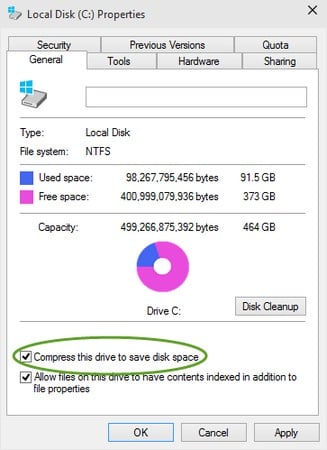 Employ NTFS compression on an unabridged bulldoze.
- Make sure you're using an ambassador business relationship.
- Bring up the Windows 10 File Explorer by clicking the File Explorer icon. On the left, cull This PC.
- On the left, tap and agree downwardly (or right-click) the folder you lot want to compress. Choose Properties, and click the Advanced button.
- Select the Shrink Contents to Save Disk Space check box. And so click OK.
Windows 10 asks y'all to confirm that yous want to compress the binder. Unless the folder is enormous, information technology should compress in a few minutes.
To uncompress a folder, reopen the Avant-garde Properties dialog box (right-click the file or folder, choose Properties, and click the Avant-garde push) and deselect the Compress Contents to Save Disk Space check box.
Nearly This Article
This article tin can exist found in the category:
- Windows 10 ,
Source: https://www.dummies.com/article/technology/computers/operating-systems/windows/windows-10/how-to-compress-windows-10-files-and-folders-with-ntfs-255270/
Posted by: tolartherect.blogspot.com
0 Response to "How To Compress On Windows"
Post a Comment